CULTURAL REGION, PACIFIC OCEAN
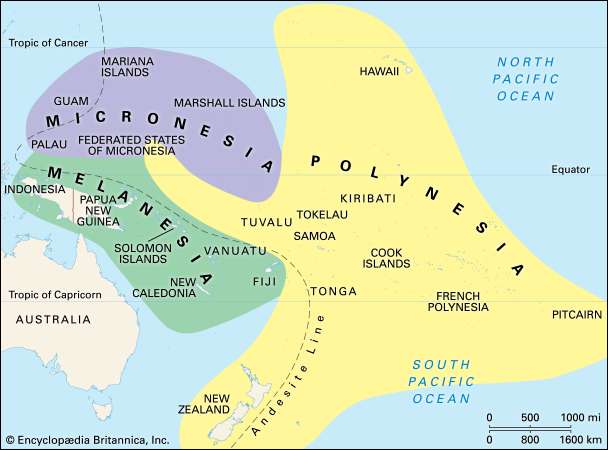
Polynesian culture, the beliefs and practices of the indigenous peoples of the ethnogeographic group of Pacific Islands known as Polynesia (from Greek poly ‘many’ and nēsoi‘islands’). Polynesia encompasses a huge triangular area of the east-central Pacific Ocean. The triangle has its apex at the Hawaiian Islands in the north and its base angles at New Zealand (Aotearoa) in the west and Easter Island (Rapa Nui) in the east. It also includes (from northwest to southeast) Tuvalu, Tokelau, Wallis and Futuna, Samoa (formerly Western Samoa), American Samoa, Tonga, Niue, the Cook Islands, French Polynesia (Tahiti and the other Society Islands, the Marquesas Islands, the Austral Islands, and the Tuamotu Archipelago, including the Gambier Islands [formerly the Mangareva Islands]), and Pitcairn Island. At the turn of the 21st century, about 70 percent of the total population of Polynesia resided in Hawaii.
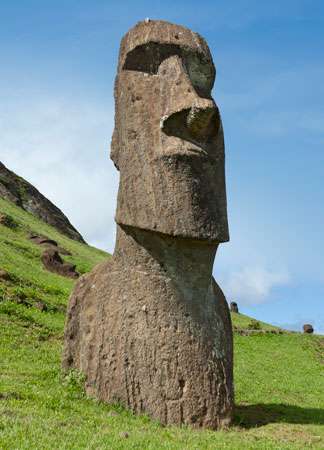
The physical environment of the Polynesian islands is not as favourable for human habitation as it might at first seem. It certainly presented difficulties when the ancestors of the Polynesians entered the area some 2,000 to 3,000 years ago, first settling on the western islands—Wallis and Futuna, Samoa, and Tonga—which were devoid of much that was needed for human habitation. As a result, early peoples had to take in a wide variety of subsistence items, including most of the useful plants and all of the domestic animals they required. The physical environment has continued to exert a marked influence on Polynesian culture.
Polynesian cultures have been radically altered by Western colonialism. European explorers navigated much of the area in the latter quarter of the 18th century, and the first missionaries arrived in the late 1700s and early 1800s. Britain annexed New Zealand through the Treaty of Waitangi (1840), but interethnic tension arose between the indigenous Maori. Other colonial powers that laid claim to various parts of Polynesia included France, Germany, New Zealand, the United States, and Chile.
Festival activity, which has always been a significant part of Pacific culture, has provided a vehicle for expressing contemporary indigenous identities. The Festival of Pacific Arts, founded in 1972, has become a major venue for the perpetuation of the region’s arts, music, and dance. With the goal of reviving what was in danger of being lost, the festival is held every four years, each time hosted by a different country. It has become an event that is both cultural and political and that serves to promote Pacific values. The Festival of Pacific Arts is complemented by other, more-local arts festivals, such as the annual Heiva in Tahiti, the annual Teuila Festival in Samoa, and the annual Merrie Monarch Hula Competition on the island of Hawaii.
Polynesian Tattoo: History, Meanings and Traditional Designs
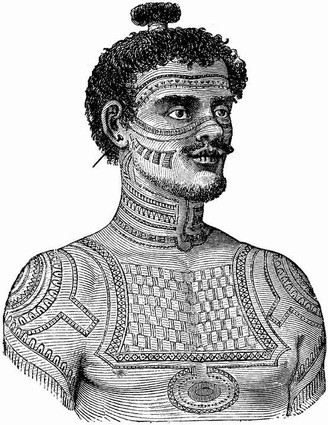
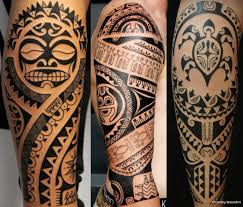
Historically there was no writing in Polynesian culture so the Polynesian’s used tattoo art that was full of distinctive signs to express their identity and personality. Tattoos would indicate status in a hierarchical society as well as sexual maturity, genealogy and ones rank within the society. Nearly everyone in ancient Polynesian society was tattooed.
The Polynesian islands that were first first visited were the Marquesas Islands, which were found by European explorers and the Spanish navigator, Alvaro de Mendana de Neira, in 1595. However, the European navigators showed little interest due to the lack of valuable resources.
Captain James Cook (as mentioned in our comprehensive guide to Maori tattooing) was the first navigator trying to explore the aforementioned Polynesian triangle.
In 1771, when James Cook first returned to Tahiti and New Zealand from his first voyage, the word “tattoo” appeared in Europe. He narrated the behaviours of the Polynesian people in his voyage, which he called tattaw. He also brought a Tahitian named Ma’i to Europe and since then tattoo started to become rapidly famous, predominently because of the tattoos of Ma’i.
Another legend is that European sailors liked the Polynesian tattoos so much that they spread extremely fast in Europe because the sailors emblazoned the tattoos on their own bodies.
The actual tradition of Polynesian tattooing existed more than 2000 years ago, however in the 18th century the Old Testament strictly banned the operation. Since it’s renaissance in the 1980s, many lost arts were revived but it became very difficult to sterilise the wooden and bone tools that were used for the tattooing process so the Ministry of Health banned tattooing in French Polynesia in 1986.
The revival of the art and practice of tattooing, particularly in Tonga, in recent years is predominantly referred to as a result of the work of scholars, researchers, visual artists and tattoo artists.
 ArtisticallyCultured